Artificial intelligence (AI)-driven chatbots, tools, and techniques are being deployed across various stages of electric vehicle (EV) design and simulation to support validation and manufacturing. AI can be used as an assistant to increase the effectiveness of conventional EDA tools. When combined with data-driven methods, it can also be used to create reduced-order models (ROMs) for advanced EDA implementations.
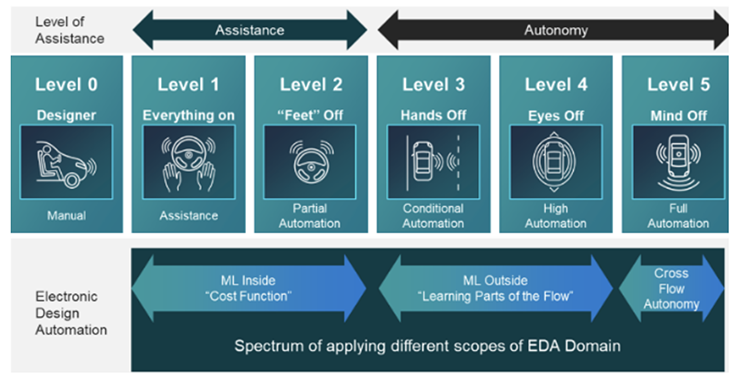
The use of AI and machine learning (ML) for EV design and validation can speed up the process and produce a higher quality of results (QoR). The use of AI and ML in EV EDA is not an “all or nothing” situation. Rather, it can ideally be viewed as a continuum.
At the beginning of Level 0, there’s no AI/ML assistance; instead, designers manually apply EDA tools. Next, in Levels 1 and 2, AI/ML tools are added in various forms to aid and improve the efficiency of the manual process. Design autonomy begins in Level 3, with full autonomy achieved at Level 5.
Even at Level 5, the design must be reviewed, validated, and approved by experienced designers, but the overall process delivers a higher QoR and faster design times (Figure 1).
Level 1 and chatbots
All Levels of implementation are being used or are in advanced stages of development. Level 1 is already in use, and increasingly so. AI-powered chatbots and generative AI for Level 1 are available for various aspects of EV design and evaluation.
For example, generative pre-trained transformer (GPT) assistants have been developed for EV developers to use when validating software and systems, including:
- Vector CANoe CAPL AI assistant with ready-to-use CAPL scripts, code snippets, and debugging help for CANoe network simulation and ECU validation.
- ADAS validation AI assistantthat generates ADAS test cases, steps, tools, logging, and automation scripts for HIL, vehicle, and simulation testing.
- EV powertrain validation AI assistantfor test case generation and automation for battery management systems, inverters, motors, onboard, and external chargers.
- Automotive functional safety validation AI assistant for ISO 26262-based test generation, safety analysis, and scripts for ECU safety functions.
Chatbots provide an entry point for using AI and ML in EV design and validation. Many EDA vendors are providing a new generation of tools and capabilities that are reshaping the EV EDA landscape across all levels of the AI/ML EDA continuum, from the entry point to advanced Levels 4 and 5.
These tools enable faster innovation, improved efficiency, and the development of smarter, more sustainable electric vehicles. At the higher levels of the continuum, ROMs are being deployed to maximize their benefits.
AI, ML, and ROMs
The use of ROMs, developed using AI and data-driven methods, allows designers to create accurate, computationally efficient models that capture the essential behavior of EV components and systems with intricate dynamics between subsystems and large datasets.
AI/ML tools like long short-term memory (LSTM) networks and dynamic mode decomposition (DMD) can be combined when developing ROMs.
LSTM neural networks can be trained on data generated from the full-order model to develop a ROM representation of the system’s dynamics. An LSTM is a type of recurrent neural network (RNN) that excels at processing large quantities of sequential data and capturing long-range dependencies and interactions.
While LSTM learns complex linear relationships within datasets, the DMD data-driven technique identifies dynamic modes from time-series data, providing a way to analyze and reduce the complexity of the nonlinear characteristics of systems.
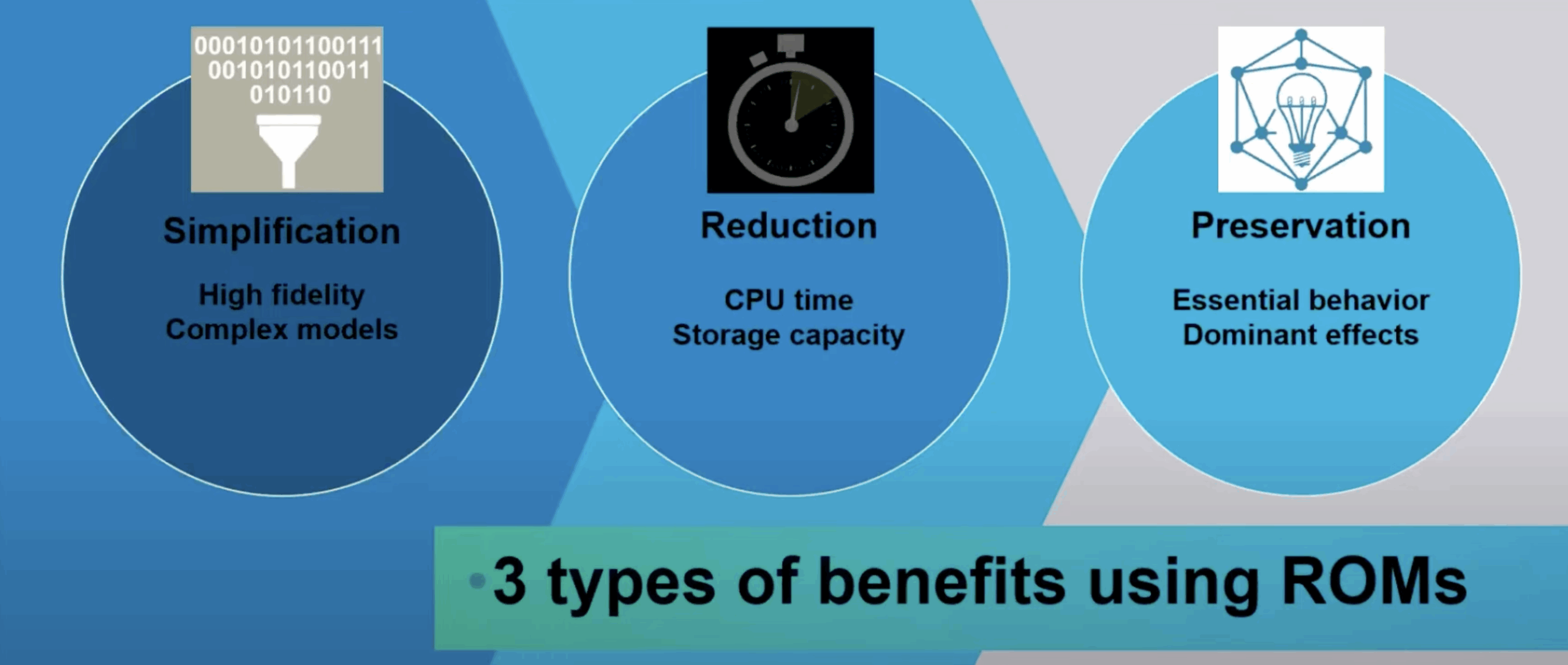
Open-source databases containing numerous EV designs, including drivetrain, battery systems, aerodynamics, and other data, can be used to train ROM models. Key benefits of using ROMs in EV simulation and design validation include simplification of complex models, which leads to a reduction in the required storage for the model and reduced CPU time for the simulations, while retaining all the essential behaviors of the system (Figure 2).
Summary
There’s a continuum of levels for applying AI and ML tools for EV design and validation, from simple chatbot interfaces to sophisticated ROM implementations. All are being used to accelerate and improve EV designs. Most EDA vendors are integrating AI and ML into their EV development software offerings.
References
Accelerate your electric vehicle design with generative design tools, Siemens Aerodynamics-guided machine learning for design optimization of electric vehicles, Communications Engineering AI for Electrification, MathWorks AI in Automotive Testing: Transforming the Future of Vehicle Safety, Sapien AI In Electric Vehicles, Meegle Computer Vision in Electronic Vehicle (EV) Manufacturing, LandingAI How AI is making electric vehicles safer and more efficient, IBM How Is AI Infusion in EDA Fueling the Automotive Revolution?, Cadence Modern AI and Machine Learning to Accelerate Electric Vehicle Simulations, SmartUQ Machine Learning for Advanced Batteries, National Renewable Energy Laboratory Next Generation of Electric Vehicles: AI-Driven Approaches for Predictive Maintenance and Battery Management, MDPI Energies The Role of AI in Electric Vehicle Simulation, Neural Concept