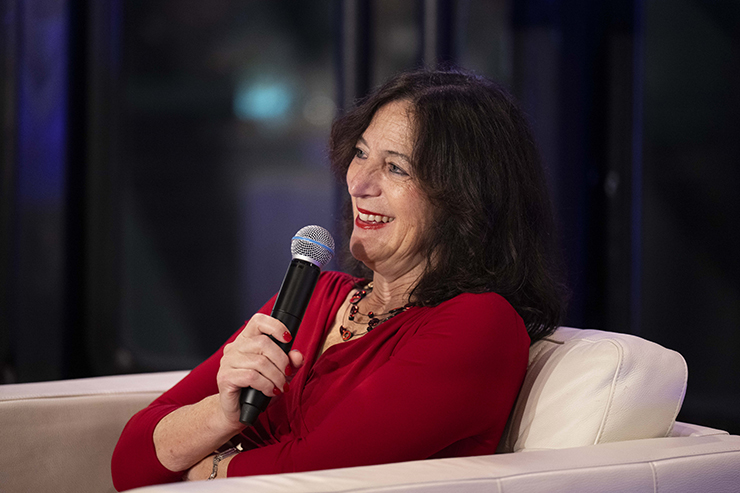
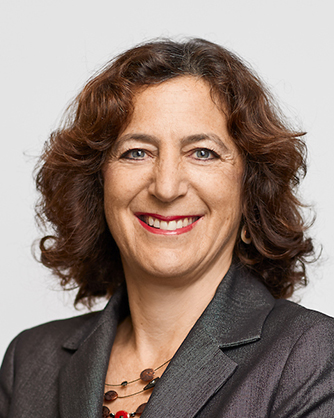
In this wide-ranging conversation, Andrea Goldsmith reflects on a career that has helped define modern wireless communications, from foundational work in channel capacity and adaptive modulation to shaping MIMO, AI-driven systems, and the road to 6G. One of the field’s most influential voices, and recipient of the 2025 IEEE Mildred Dresselhaus Medal for her contributions to and leadership in wireless communications theory and practice (just one of many honors in a career spanning academia, industry, and university leadership), she speaks candidly about her foundational work in the industry, the importance of diversity, and the need for boldness and collaboration in driving engineering excellence.
EEWorld: How did you find your way into engineering and the work that’s made up your very successful career?
Dr. Goldsmith: Yeah, and I can spend the whole time just talking about that one particular question. So, my dad was a professor of mechanical engineering at Berkeley, and he really thought I should be an engineer. I really liked everything as a student in high school, and then I traveled through Europe, where I learned about international politics, languages, and many other things. And so, when I started at Berkeley, my dad wisely advised that I declare engineering because my grades were going to drop precipitously, and if I didn’t declare engineering going in, when I had good grades from community college and high school, I wouldn’t be able to get into engineering. He was very right about that, so I declared engineering going in as a freshman.
I’ve said in other venues that I really struggled that first year. I had not been in my senior year of high school. I left high school in the middle of 11th grade, went to community college, and then spent what would have been my senior year in high school, or my final year in community college, traveling. So, I wasn’t prepared for the engineering classes. I was taking many other classes, again, based on the experience I had traveling in Europe on politics, languages, and philosophy, and so I really wasn’t sure I should stay in engineering, especially since I was struggling with it. But in the end, after my first year, my freshman year, I caught up with the material I needed to have as foundational to take the engineering class.
My sophomore year, I did well. That first semester of my sophomore year in engineering, I took a political science class that was a prerequisite for the major, which was quite boring. It was a very simplistic philosophy about European politics, that democracy diminishes as you move from west to east across the map of Europe. And I lived in Europe, and I didn’t think that was a very good characterization of European politics. And so I just decided that engineering would be a good foundation for whatever I wanted to do next, that anything I could do with a political science undergraduate degree, which is what I was considering, instead of engineering I could do with an engineering degree, but not vice versa, and so that’s why I ended up majoring in engineering as an undergraduate, but it’s certainly not why I stayed in engineering.
I really credit staying in engineering with my first job out of college, which was at a defense communication company. I was very fortunate in college to have a fantastic academic advisor, Aaron Tamasian, who was a statistician; he did a lot of work in communication theory. When I said to him, ‘I’m interested in the theoretical side of engineering,’ he said, ‘Well, communications is a great field for you to study.’ So that’s what I ended up focusing on as an undergraduate.
Then I went to work at a defense communication company right after undergrad. There were no commercial wireless jobs because cellular was just starting to roll out. There was no Wi Fi. There were certainly no interesting communication jobs in the Bay Area. So, this was a defense company in the Bay Area. We were working on really interesting communication problems, satellite systems, and multiple antenna rate systems. The company had primarily new graduates like me with bachelor’s degrees and very little experience, and PhDs. Working with those PhDs, they thought about problems differently and understood the deep theory and application to build Advanced Wireless systems. I got motivated in that job to go back and learn more about wireless communication. Basically, I became hooked in that first job on the magic of wireless communication, I went back to grad school, and I’ve been in the field ever since, for decades now, and I am still enthralled with the magic of wireless communication in the same way as I was back in the 80s, when I was a new graduate out of college and working on some very early communication systems, long before cellular and Wi Fi were launched nationwide and globally.
EEWorld: I feel like when I talk to people, they have one of two back stories. It’s, ‘My father and his father before him were all engineers.’ Or it’s like, ‘I kind of fell into it, and then I fell in love.’ Both of them have their charm, but I think the ‘I kind of fell into it,’ especially with engineering, is so interesting to me. And you kind of have both.
Dr. Goldsmith: Yeah, it’s interesting, because when I was a kid, and I knew my dad was an engineer, I thought that was someone who drove trains, so I really didn’t know what engineers did. And I didn’t grow up with my dad, so I didn’t see what he did every day as an engineering professor. So it really was college and then that first job, because I didn’t have any internships as a college student, I was working my way through college as a waitress, so I didn’t have the opportunity to really understand what an engineering job was like until my first engineering job, and I was just very fortunate that that was the job that I got, because I got a lot of responsibility. I was working on really interesting problems, and I was surrounded by really brilliant people with advanced degrees. And I think it was that combination that made me fall in love with wireless communication and with wireless communications research.
EEWorld: I think the best motivation is passionate people.
Dr. Goldsmith: Absolutely. I think that also speaks to the value of teaching and education, that I’ve talked to so many students who become passionate about a topic because of a teacher, a high school teacher, a college teacher, who just made that topic come alive in ways that they could not possibly imagine without that person articulating why it was such an interesting topic. And I’ve had the opposite in my own experience and others who people who think they want to be an engineer or a physicist or a mathematician or a social scientist or political scientist, and they have a bad teacher, as I did in college in political science, where it completely turns you off to the field. So, I think that as educators, we have such a responsibility to ignite the passion and curiosity of our students by bringing alive what’s so special about the topics that we teach.
EEWorld: Yeah, absolutely, I agree with that.
Your early work on channel capacity and adaptive modulation helped define modern wireless systems. What do you see as their most important real-world impacts today?
Dr. Goldsmith: That’s a wonderful question, and the way that I was introduced to Shannon theory was as a first-year graduate student. I was a master student. I hadn’t even made it into the PhD program yet, and this was in 1989, the fall of 1989, when the second-generation cellular standard debate was happening, and it was a fierce debate. There were different analog first-generation cellular standards in every country in Europe. The US had a single analog standard amp, which was unified around the country, which makes a big difference when you’re looking at economies of scale, roaming, and other issues of seamless connectivity.
So, for the second generation of digital standards, there were three different standards that were being debated for the United States: Frequency division, FDMA, time division, TDMA, and the GSM standard in Europe, which was OFDM-based and CDMA. So, four different standards around the world were being developed. I remember going to my advisor, Praveen Varaiya, who was brilliant and an incredible mentor, advisor, and friend, and saying, ‘Well, how do you decide which is the right standard to adopt?’ And he said, ‘You should look at the fundamental capacity limits of the channel, and that will help give you intuition about the right way to communicate at the physical layer.’ I didn’t know anything about channel capacity. I’d never heard of Shannon theory, so I went and read Shannon’s paper from 1948, which is an absolutely beautiful, beautiful paper that every communications engineer should read, everyone should read. It’s beautiful paper, and it was very theoretical, but it really gave a lot of insight into how you reach the capacity limits of a WGN channel with additive noise. And I thought, ‘I wonder if we can apply these ideas to a wireless channel, which is changing over time.’ I was sure that somebody had solved that problem before. I think, like many new graduate students, you find a problem, and you think, this is just such an obvious problem. Somebody must have solved it.
It turns out nobody had solved it, at least in the way that I actually posed it, which was to say, if the channel is changing over time, and you can measure the channel instantaneously at the receiver and feed that back to the transmitter, which allows you to adapt to the channel, what is the Shannon capacity of a channel under those conditions? It turned out that asking the right question was the hardest part of solving that problem, because the solution was actually quite simple. It was a Lagrange multiplier problem from first-year calculus to solve, but the solution gave a lot of intuition about the optimal way to communicate over a channel that’s changing with time, when you can measure it, and feed back that measurement and adapt to the channel.
So basically, I solved for the Shannon capacity of the channel, and then I submitted that paper to a conference. It was rejected, and I think in part because I didn’t write the paper very well. My advisor was not in communication theory, so he was unknown. I was unknown. We didn’t get the benefit of the doubt. I was solving a much broader problem than the one that ended up being the most important part of solving that problem. So, it was also a lesson in failure, you know, getting your first paper rejected. Rather than just giving up and saying, ‘This isn’t an interesting result,’ deciding, ‘Okay, the reviewers have some good points here. How do I address that?’ I resubmitted the paper later on, addressing the concerns of the reviewer, and it’s my most cited paper, or was one of my most cited papers. All from the intuition of how you adapt to the channel, which is, when the channel is good, you send higher data rates. When it’s bad, you send lower data rates. When it’s really bad, you don’t send any data.
I was at Bell Labs the following summer. After finishing this result, I was working with Jerry Foschini, Larry Greenstein, and some other people at Bell Labs who are very knowledgeable about actually designing modulation and coding schemes for channels. I came across a paper that Jerry Foschini had written on the optimal data rate to send over a channel at a particular SNR. I realized that if you inverted their formula, you got the exact same formula as the Shannon capacity formula with a coding gain term.
I then took that result and said, ‘Okay, well, now this tells me exactly what the adaptive modulation scheme should be to achieve channel capacity minus the coding gain.’ That’s where my work on adaptive modulation came from. So these ideas were very simple and very intuitive, and I think that’s why they have so much impact in practice, if you look at every generation of cellular and Wi Fi systems, certainly starting from not the CDMA systems or G, but the 4G and beyond cellular and all of the Wi Fi systems, starting with ADA two point 11, A and G, they all use adaptive modulation with the same ideas as were in those early Shannon capacity papers and adaptive modulation papers that I wrote, which again is, when the channel is good, you send it a higher data rate. When it’s bad, you back off. So, when you have five bars, you send them at a very high data rate. When you have three bars, you said in the lower data rate, when you’re down to one bar that’s kind of coming in and out, you may not be able to get any data through. Those were the foundational ideas in that early work, which ended up making their way into the standards that we use today in all cellular and all life. My system.
So, it was very gratifying to see foundational theory, Shannon theory, which is all math, coupled with intuition, which I think I brought from the work that I had done when I finished my undergrad. I was working on the satellite systems and multiple antenna systems to solve a theoretical problem and then see how that theory could actually inform the practical application of wireless communication. It was a very gratifying experience to couple theory and practice in that way. And I credit the theoretical foundations that I got in my undergraduate and graduate studies, as well as the practical experience I had building wireless systems, to bring those two together in a way that really coupled the theory and the practice, and that, in the end, had maximum impact in real-world technology today.
EEWorld: Yeah, wow, that’s a great story.
Multi-antenna and beam forming techniques are now foundational in 5G and beyond. What breakthroughs or challenges from that research era still shape your thinking?
Dr. Goldsmith: It’s interesting that I was very fortunate to work at Bell Labs two summers throughout my PhD, and a lot of the work, the foundational work on multiple antenna systems, came out of Bell Labs. So, I was even before the papers were published, I was working with people like Jerry Foschini and Jack Winters and seeing those ideas coming alive. It was the very early days and the very early realization that if we added multiple antennas at both the transmitter and receiver, we could scale data rates linearly with the number of antennas at both ends. Beamforming had been around before that.
In fact, when I was working at Maxim, before I went back to grad school, we were working on antenna Ray processing techniques, and I went to read some of the foundational papers written by my later Stanford colleagues, [Arogyaswami] Paulrajand Tom Kailath and Dick Roy on the music and esprit algorithms, which are about direction finding, which is similar to beamforming. It’s just direction finding is at the receive end and beam forming is at the transmit end, but it’s similar to antenna Ray processing, where you’re steering a beam in a particular direction. The multiple antenna techniques of MIMO allow you to actually increase data rates linearly.
So, I feel incredibly fortunate to have been a young researcher at a time when these breakthrough ideas were just starting to take shape and their impact was starting to take shape. And of course, it’s foundational in Wi Fi, because multiple antenna techniques, of which beamforming is a subset, really are essential for both reliability and high capacity. And as we continue to scale the number of antennas at both the transmit and receive ends of a wireless link, we get more capacity, higher data rates, and better reliability. Now the question is, are we kind of towards the end of the innovation that we’re going to see with respect to multiple antennas?
Multiple antenna techniques first came about in the 90s, and they’ve evolved since then. There’s still work to be done, especially as we go to higher frequencies like millimeter wave, where reliability is challenging, there’s a lot of spectrum out there, so we don’t need multiple antennas to give us higher capacity, but we do need multiple antennas to be able to steer the beam at these very high frequencies in order to get any kind of distance and any kind of reliability. So, I think that there’s still work to be done on multiple antenna techniques for millimeter wave communication. And then the other place where I think there are interesting innovations in MIMO and multiple antenna techniques is in a large system where you have a base station that’s serving many users. How do you optimally allocate your antenna resources to the different users? We haven’t really solved that problem in any kind of optimal way. AI is coming in as a new tool that we can apply to that problem. I think there is always an insatiable demand for more data, faster data. There is always a demand for higher reliability. I mean, it’s interesting. Here we are in the fifth generation of cellular and the sixth or seventh generation of Wi Fi, depending on how you view the generations, and we still drop calls in places where we really need to make phone calls. So, there’s always a need for higher reliability and higher data rates.
I think multiple antennas are going to continue to be a key ingredient in the demand for higher reliability and higher data rate. We need to continue to increase the number of antennas that we can fit on a small device, as well as in the base station. We need to drive down the cost of adding more antennas, both, of course, at the end device level as well as at the base stations. And then, as we look to 6G, which we still don’t know what the killer application for 6G will be, beyond what we can do with 5G, or if there will be one at all. We have to think about new devices. So, if we’re using these systems for self-driving cars, or robots, or glasses, or smart Internet of Things devices. How are we going to use multiple antennas in a way that ensures connectivity and reliability in applications where the data ring may not be that important, but reliability and latency are key? I think that there’s still a lot of room for new problem formulations and solutions for multiple antenna technologies going forward into the next generation of both Wi Fi and cellular.
EEWorld: Thank you for your insight.
Where do you see the biggest gap between what information theory says is possible and what current communication systems can deliver?
Dr. Goldsmith: This is a really interesting question, because information theory, coding theory, and communication theory have been declared dead many times over in many different decades, meaning that we’ve solved all the interesting problems, and there’s no more interesting problems to solve. I think that is sometimes said about information theory today, in part because we are very close to the Shannon limit of what we can do in a point to point wireless channel, either that is static or that is changing slow enough, so that we can measure the channel at the receiver, feed it back to the transmitter and adapt that was the basis of my research back in the 80s and 90s, and the basis of a lot of the standards that we have today. But there’s a lot of information theory about wireless communication systems that is still open.
In particular, if we can’t measure the channel, if we don’t know exactly what the channel is that we can communicate over, and Shannon theory forces us to have zero probability of error, which is what Shannon theory is based on, then you cannot communicate any faster than the worst-case channel, which can have zero capacity. Obviously, that’s not an interesting result from a practical perspective that if you have one bad channel, you drive through a tunnel, or you call is dropped, driving down the street, then you basically give up on communicating. That isn’t a practical solution to the fact that the channel is changing. So, what is the right way to think about Shannon capacity, when you can have errors, or when you don’t have infinite block length codes, or when you have multiple users?
If you think about a cellular system, we don’t know the Shannon capacity of a cellular system because we don’t have good solutions for how to solve the interference problem. I think that there are still a lot of open questions in the Shannon capacity limits of a cellular system or a Wi Fi system, particularly, how you deal with interference, how you deal with changing channels that you can’t measure, and how you deal with constraints that aren’t part of Shannon’s original theory? Meaning latency constraints, which means you don’t have infinite block lengths, and you don’t have a probability of error going to zero. There have been advances in coding and other practical techniques to deal with those constraints, but we can’t point to the Shannon theory because it doesn’t exist, and say, ‘Okay, those practical solutions are getting as close to the Shannon limit.’
When I think about the biggest gap between what information theory says is possible and what we’re doing today, I think the problem is that we don’t have the Shannon capacity limits for what a cellular system can do. And that means that as we’re looking to apply new and innovative techniques, either at the physical layer, when we don’t know the channel, or we have energy constraints or block length constraints, or probability of error is nonzero, or even more importantly, in the mode. To the user context, where we’re doing frequency reuse, which is inherent to cellular systems, that introduces interference, and we don’t have good ways of dealing with interference.
In Shannon theory, there are a lot of open questions that a lot of smart people have tried to solve for many decades and have not been able to solve satisfactorily in a way that gives us intuition about what we should implement in practice. So, I think the biggest challenge is that we don’t have the underlying theory to say, what are the breakthroughs in innovation that we should or might introduce in the design of our cellular systems that will get us closer to the Shannon capacity, because we don’t know the Shannon capacity, so we don’t know how close we are to it.
EEWorld: Looking ahead to 6G and future networks. What do you view as the most urgent technical challenges the field must solve?
Dr. Goldsmith: That’s easy and hard. I think the biggest challenge is what the next generation of cellular enables that we can’t do with 5G, and how do we build a network that enables that? I was at the 6G summit, and that was one of the things I was thinking about in watching the talks about what 6G is going to enable. Many of the things that were discussed were also discussed in 5G about what 5G would enable, and many of the quote, unquote, potential ‘killer apps’ for 5G haven’t come to pass. Does that mean that we just weren’t mature enough in terms of technology to enable them? Does it mean that users are not ready to pay more money for these kinds of applications? Does it mean that the technology is not caught up to being able to deliver these applications like every device is connected to the internet, we can do self-driving cars and robots and smart glasses and all these other things, again, that were promised in 5G so I worry a little bit about the fact that we are already working on standardization of 6G when we don’t necessarily know what it will enable beyond 5G and what consumers will be willing to pay for.
There’s also Wi Fi, which a lot of wireless traffic goes over. Wi Fi, it’s faster, there’s more bandwidth. You’re not trying to do this over large distances or at rapid speeds of movement. So, what should 6G, assuming that that’s referring to the next generation of cellular, enable, and how do we build a network that supports it?
There was a lot of talk about AI in the 6G summit and in other technical symposia that I’ve attended. And AI, I think, is a very, very powerful tool that will integrate into the next generation of wireless networks in two ways. It will be used as a tool to optimize the networks and to allow them to perform better. There are problems in the optimization of wireless networking, even just resource allocation. That’s always been an NP-hard optimization problem, and I think AI can play a role in optimizing resource allocation for wireless networking, which can be very powerful. I also think that the other side of the coin of AI and wireless is that distributed AI over wireless networks is going to be an interesting application, and perhaps the killer app for 6G. It wasn’t really a thing in 5G, as we were rolling out 5G networks, that people wanted AI on every device, and that they could use AI on different devices in a distributed way to do distributed learning and distributed inference, I think that may drive traffic in ways for the next generation of cellular that we haven’t seen until now, where there’s a lot more uplink traffic, as opposed to mostly downlink traffic.
So I think AI is going to be an interesting new phenomenon as a tool to design and operate wireless networks better, and also as an application to drive more data traffic and more demanding requirements on the network, which in turn, if this is something that consumers want on their phones and their wireless devices, will potentially lead to new revenue sources, which will then lead to the deployment of these next generation of networks. But that remains to be seen, because that was also the promise of 5G that has not completely panned out as advertised. Back when we were looking at developing 5G networks.
EEWorld: You’ve combined academic research with entrepreneurial work at Quantenna and Plume. What lessons from industry most influence how you think about future wireless technologies?
Dr. Goldsmith: So, my work at Plume and Quantenna was transformational in my research. One of the interesting things when we, as academics and academic leaders, talk about the importance of entrepreneurship and innovation, is that ideas are making their way out of the research labs of universities and into practice, so that universities can have a greater impact by having the impact of our ideas be broader than just within the university.
One of the things I learned when I was at Plume and Quantenna is that even without faculty members and graduate students and undergraduate students taking their ideas out into practice, a lot of people in industry read the papers that we write. I remember my first Wi Fi standards meeting. This was back in 2007 or 2008, when multiple antenna Wi Fi systems were starting to be deployed and standardized. And I thought, at this first standard meeting, ‘I’m not going to know anybody, and nobody’s going to know me, because I don’t go to standards meetings. I go to academic research meetings.’ I knew many of the people because they were former students of Stanford and Berkeley, people that I had worked with or been colleagues with or in student cohorts with, and they knew me because they were reading my papers in the papers of my colleagues in wireless.
The impact of academic research on practical technology development in wireless and many other areas is tremendous. I think what’s really helped to contribute to the leadership of our country in technology, as well as medicine and science, is academic research. What I didn’t expect when I came back from Quantenna and Plume was that I had seen my research at Stanford and earlier at Berkeley. Those ideas made their way into the technologies at Quantenna and Plume, and so that was exactly as advertised, academic research, because the faculty member who did that research and went out and started a company had the foundational knowledge to create world-leading technology. So that was expected. But what I didn’t expect was when I came back to the university from these startup experiences, my research changed because I had actually seen how the theoretical research that I was doing, because I’m a theorist, so I wasn’t building stuff in academia. Actually, going out and building technology based on research that I and others had done changed the way I thought about research.
When I came back to Stanford after my leave at Plume and Quantenna, I actually started doing research in areas that I hadn’t thought about before, like A to D conversion and other topics, low energy, wireless communication, and looking at mitigating nonlinearity issues in physical layer design. So many things that I had seen were real barriers to the practical implementation of theoretical research. I thought, well, we should do theoretical research on getting around those barriers. So, when I think about what lessons from industry most influence how I think about future wireless technologies, it is so important that universities and companies have partnerships. Know the challenges of building state-of-the-art technology, which is their goal: to build the best technology and sell it.
Academics are looking for interesting research problems that they can solve, and many of those interesting research problems can come from industry. But academics are not the R&D arm of industry. We have longer time horizons. We have students who are looking for important, deep research problems to solve, not something that they need to solve to get the next tape out or the next generation of product out. And so I think that the partnership between industry and academia on identifying the most interesting problems that academics can solve, having academics do what they do best, which is really dig into really important foundational problems, some of which it may not be apparent how they’re going to be used in practice or when They’re going to be used in practice, but that foundational research is what’s given in America its technological edge for generations.
So, ensuring that we have the best partnership between academia, industry, and government to continue that research leadership by allowing universities to do fundamental research, but also engaging with companies so they understand the challenges in practice for foundational research ideas to make their way into practice and have a significant impact on technology leadership. That’s my takeaway from not only my experience starting two companies, Plume and Quantenna, in the developing world, leading technologies in those companies, but also my decades of research at the university in the field of wireless communication, which is of a lot of interest to industry. And therefore, I was able to interact deeply with many people in the industry and understand the challenges that they’re facing in developing the best technology and implementing it, and really partner with them to create foundational research that helps address their medium to long-term technical challenges.
EEWorld: Hearing your opinion on that makes me feel so much better that you’re still in academia and able to help build those bridges.
Dr. Goldsmith: Yeah, I never wanted to leave academia. I mean, I’ve had opportunities to work in the industry or to stay with my startups, but my heart really is in the university. I think the mission of a university is around education, research, and healthcare, now with Stony Brook, because we run a large medical set of activities. That’s what gives me joy and purpose every day that I get up professionally, and so I would never leave the university, but I do very much value my partnership with people in industry, not just now, but throughout my career; it’s really been transformative in the research that I’ve done and the impact that it’s had.
EEWorld: You were using AI/ML for wireless research at Stanford well before chat, GBT, and other AI tools were available. What AI tool did you use, and how did you collect enough data to teach the model?
Dr. Goldsmith: It’s interesting because the AI/ML that we used for wireless at Stanford came about because of a postdoc, Nariman Farsad, who was doing some very interesting work in molecular communication, and I thought that was very intriguing. Having worked in wireless communication my whole career, this was a completely new way to communicate. It wasn’t digital communication; it wasn’t analog communication. It was using molecules to send bits, which I thought was really intriguing.
So everyone joined my lab, and the problem with molecular communication is the molecules stick around in the channel, which is a liquid, for a really long time, because it takes a long time for them to dissipate, which means that you have an equalization challenge, because you have the old data that’s still hanging around the channel, that’s corrupting the new data that you’re trying to send. This is not a channel that obeys Maxwell’s equations. It’s a molecular channel. It’s differential equations that define how molecules diffuse through a liquid. And so, we were looking at how we equalize a channel that doesn’t obey Maxwell’s equations, and the traditional forms of equalization aren’t necessarily applicable. There’s a lot of memory in the channel, so it’s way too complex to apply things like Viterbi equalization.
He suggested that we look at machine learning as a way to equalize the channel. And I said, ‘Well, you know, machine learning and AI have been hyped up a lot for at least the last decade,’ and a lot of people were jumping on the AI bandwagon, even back then, about eight to 10 years ago. I generally don’t like to jump on a bandwagon. So, I said, ‘Well, I don’t know that we should delve into looking at AI ml, but why not? It’s a new tool.’ Was very new at the time, as you said, Chat GPT hadn’t come out yet, but we did have deep learning models that were far more powerful than anything that had come about before.
So, we applied that to equalizing the channel, and it ended up doing way better than any other state-of-the-art equalization mechanism for molecular communication. And it even ended up beating the Viterbi algorithm when you had a constraint on complexity, or you didn’t have perfect knowledge of the channel, and that was really intriguing to me, the fact that this tool, which we really didn’t understand very well then, and we still don’t understand very well now, could be the theoretical optimal solution under circumstances where the theory was not directly accurately applicable. Because, again, you didn’t know the parameters of the channel model perfectly, or you had a complexity constraint. So based on that early work, we ended up doing more on the application of AI/ML to channel equalization, and found similar results, not for molecular communication, but for more traditional wireless and wireline communication, that AI/ML could be the Viterbi decoder for equalization when the channel was not perfectly known, or you have a complexity constraint.
So how do we collect enough data? I mean, part of it was using data collection to figure out how well you can train the model, how long you need to train the model? How much data do you need? These were relatively static channels, so when the channel changed, retraining was a big deal, because it takes a long time to retrain. But we found that the models that we were using and had developed actually were quite robust to changing channel conditions, more robust than traditional Viterbi decoding, because the AI/ML was not looking to invert the channel, which is what a traditional equalizer does. It was looking to learn the channel well enough to figure out what data was sent over the channel. That turned out to be more robust to the channel changing than traditional techniques.
So, there were a couple of kinds of mega themes that I took away from that work. The first one is that Emma AI/ML is a powerful tool for communications, and we should explore how it can be used, even when we have theoretically optimal solutions that may not be the right solution depending on complexity constraints and how well you know the parameters of the model that you’re optimizing for. I think that’s also why Chat GPT and large language models have been so much better at speech recognition than our previous techniques of hidden Markov models, because those were very sophisticated mathematical models, but they weren’t accurately modeling speech. So, AI/ML, which isn’t trying to accurately model speech, it’s just trying to figure out what was said or what the next word should be, is a very powerful tool for that.
My takeaway on how to use AI/ML without completely jumping on the bandwagon and assuming we can use it for everything, because we can’t, is that AI/ML is best used in wireless communication when it’s coupled with domain knowledge. So, our students in communications need to have the domain knowledge to understand when to use it and how to use it effectively. It’s very useful when you don’t have an accurate model, because these machine learning methods are learning what they need to learn from data to optimize whatever it is that you’re trying to optimize for. They don’t actually have to learn the model, which is good when you don’t have a good model for what it is that you’re trying to learn. They’re also very powerful when you have complexity constraints and unknown parameters in your model. And I think those mega lessons have panned out in other uses of AI/ML that I see, whether it’s in medicine or communications or language or diagnostics or efficiency in operations, when we don’t have good models that we’re trying to optimize, AI/ML can be a very powerful tool.
EEWorld: As a university president, how do you think engineering education needs to evolve to prepare the next generation of wireless researchers and innovators?
Dr. Goldsmith: I think that it’s really important that students get a broad education, not just a broad engineering education if they’re going to be engineers, but a broad education in general. When I look at my education at Berkeley, even though I was an engineering student, I took classes in many different things, and I think that that made me a better engineer and a better leader.
So, what I like to articulate as a university president is that AI is a powerful tool. We need to educate our students broadly so that they have domain knowledge that they can couple with knowledge of AI. Whatever field that they’re going into, they can use this tool in the most powerful way.
We need to educate them broadly, so they have a broad view of the world that will make them better professionals, better leaders, better citizens of the world, better members of their community. So that is the challenge, not just for engineering education, but for education broadly, and certainly, it’s a work in progress, especially with AI/ML to figure out, how do we educate every one of our students to use this tool? And also, how do we use AI/ML to understand how we are educating our students, and how we can educate them better? And most importantly, what are they not learning? So that we can intervene and ensure that the students are learning what they need to know, and vitally, that they are able to be successful in their academic careers on our campuses and complete their degrees and go on to get great jobs and have great careers.
EEWorld: Okay, last question: You’ve long championed diversity and inclusion across academia and IEEE, but within all of your work, what changes have made the biggest difference, and where does the field still need to go?
Dr. Goldsmith: I was incredibly proud of my work in the IEEE around diversity and inclusion when I started doing that work. I think it was 2016; it was an ad hoc committee in the technical activities group under Josie Mora, who was the incoming VP.
To articulate why diversity is important to the field of engineering, it’s about excellence that we can’t achieve our goals of creating technology to benefit humanity if we don’t have diverse perspectives and experiences around the table designing that technology. And the reason inclusion is important is that we want all of those voices to have a seat at the table and have their voices part of that discussion.
I was incredibly proud of the IEEE for embracing those ideas, first through the technical activities board, and I was then elevated to the ad hoc committee at the Board of Directors level, and then a standing committee at the Board of Directors level on diversity and inclusion.
I do think the IEEE has stepped back from that. They took the diversity statement off the website, which I was disappointed about. They changed the name of the committee, and I think that’s unfortunate, because diversity is about excellence, and inclusion is essential for diverse voices and perspectives to be part of the engineering that we do.
So where does the field still need to go? I think that we convinced a lot of people that diversity and inclusion were essential for excellence in engineering, and more broadly, there is obviously a backlash and a political challenge to continuing to make progress in that articulation that diversity and inclusion are about excellence. Then what do we need to do to ensure that the most excellent, diverse people have a seat at the table to participate in engineering, and their voices are included? I think there’s still work to be done there. It’s a challenging political issue right now.
There are certainly issues that were raised about how diversity and inclusion were implemented, not in the IEEE, but in other organizations, taking shortcuts, hiring people because they were diverse, rather than hiring them because they were the best people, or admitting students or hiring faculty and universities, not because they were the best people, but because they were diverse. I think that that was never the right way to promote diversity and inclusion, and I’ve always said that diversity and inclusion is a marathon, not a sprint. We have to continue to work to articulate that diversity and inclusion are about excellence in engineering, and more broadly, we have to continue to work to ensure that we break down barriers for diverse people to be able to achieve their full potential and fully participate.
I think we have to ensure that the narrative that we’ve spent decades crafting about diversity and inclusion being about excellence is not negatively impacted by this political moment, that we continue to be the voice of diversity and inclusion being about excellence, and demonstrating that that is so. And I can tell you that in all of my experiences in academia, in industry, on corporate boards, in my startups, in government, I have only seen that diversity and inclusion when it is done with an eye towards enhancing excellence does exactly that. Every organization I’ve been part of is better and has more satisfaction among the people participating when it embraces diversity and inclusion.
EEWorld: Thank you so much for speaking with me. That was a great answer.
Dr. Goldsmith: Are you sure you don’t want to do one more?
EEWorld: Okay, one more. You led major multi-university research programs. What have you learned about driving collaborative innovation that truly moves wireless technology forward?
Dr. Goldsmith: I’m going to speak about that, not just for wireless technology, but more generally, in terms of thinking about collaboration and innovation. So, the multi-university research programs, I think, bring together people with different ideas, different perspectives, which is what those multi-university research programs did, is really where new ideas, new frontiers of knowledge, and new innovations come from.
When I was leading the NSF center on the science of information, I was the lead Stanford PI on that program, and that’s where I started doing research in neuroscience. I never thought I would do research in neuroscience, but it was one of the pillars of the center. And I was just thinking, ‘Well, what looks like wireless communication among these pillars and neuroscience? Well, there’s communication going on in the brain, so maybe that’s an interesting area to delve into.’ And I started working with epilepsy specialists at Stanford and talking with other people in the center, and it really led to some really innovative, bold ideas.
So that’s what I’ve seen in these multi-university research programs. Stony Brook has the largest and only quantum communication network in the country, which is interesting. I’ve been talking about the fact that there are really three ways of communication networking that I’ve seen. The first is the fired network that started with the packet transmission from UCLA to Sri, which would happen in 1969, that went from the West Coast and moved east. That’s what the wired internet became.
Then there was the cellular breakthrough, which first rolled out in 1986 in Chicago, and emanated out of Chicago to be nationwide and global. And now we have this third wave, which is quantum internet. The first network is in Long Island, starting with Stony Brook, and it goes to Brookhaven and a few data centers in Columbia, and we’re about to build a wireless quantum communication link to Yale.
So, when I think about all of the collaboration that’s gone into our quantum network, we’re collaborating with Brookhaven National Labs and Columbia to build the link there and Yale to build the link, the wireless link across Long Island Sound bringing together people that have these different perspectives and expertise and experiences and ideas is where the magic of innovation and research happens. I think these multi-University collaborations, and also multi-University/corporate collaborations, are really important.
What I’ve learned about driving collaborative innovation is connecting the right people, creating the right foundation for collaborative innovation, and just being open to new ideas, being able to take bold risks, and not worrying about failure. Because when you’re really trying to drive innovation in research and in technology, you’re going to fail sometimes because you have to try big, bold ideas that may not work the first time around, or even the second time or third time around. Being willing to do that, and having a team of people, and having leaders that support doing big, bold research that’s innovative and collaborative, that’s the foundation for where technology breakthroughs begin, and I’ve seen it throughout history. I mean, even going back to Marconi, original wireless transmissions, it’s taking big risks, making big bets, and being willing to fail on the way to doing something truly unique and innovative.